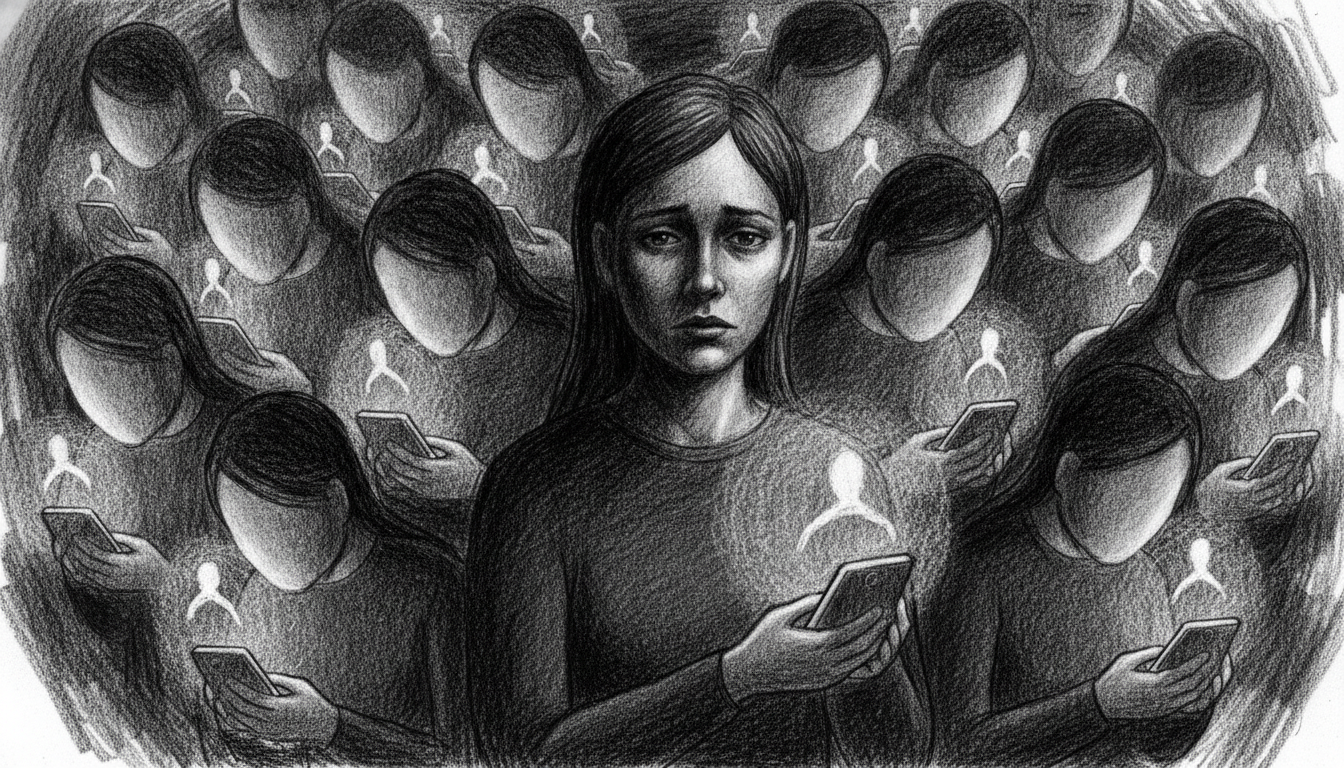
A growing body of academic literature explores the psychological, relational, and societal impacts of substituting human-to-human interactions with human-to-AI agents.
Research highlights several negative dynamics and risks:
- Erosion of Human Closeness and Interpersonal Disconnection: Replacing interpersonal dialogue with algorithmic systems diminishes face-to-face gatherings and human intimacy, altering social cohesion and community structures (Tai, 2020).
- AI Dependence and Emotional Substitution: Longitudinal and cross-sectional studies on conversational agents demonstrate that individuals experiencing psychological distress (such as depression or social anxiety) frequently rely on AI companions via escape and social motivations, accelerating digital dependence rather than resolving relational deficits (Huang et al., 2024).
- Limitations in Deep Empathy and Relational Processing: While conversational AI models can emulate active listening and surface-level responsiveness, comparative evaluations highlight structural deficits in human-AI dialogue, including a lack of genuine empathy, inability to process authentic nonverbal cues, and absence of mutual human connection compared to human-to-human interaction (Kuhail et al., 2024).
Beyond baseline feelings of isolation, recent research in human-computer interaction, cognitive science, and social philosophy categorizes the downstream effects of substituting human relationships with AI into four primary mechanisms.
1. Social Atrophy and the "Frictionless" Relational Trap
Human relationships are inherently inefficient, requiring compromise, emotional regulation, patience, and the resolution of interpersonal conflict. AI companions, by contrast, offer frictionless interaction: infinite availability, zero demands for reciprocity, and total user control.
- The Tolerance Threshold: Sociologist Sherry Turkle argues in Artificial Intimacy (2026) that using conversational agents as emotional substitutes creates an intolerance for the natural messiness of human interaction. When people habituate to agents that never interrupt, demand emotional labor, or get angry, the cognitive and emotional effort required for face-to-face relationships begins to feel unmanageable.
- Relational Displacement: Large-scale user studies on conversational agents demonstrate that while AI companions can provide short-term relief from acute loneliness, they often displace the motivation to pursue real-world friendships. The immediate reward of simulated intimacy reduces the user's willingness to engage in the vulnerable trial-and-error necessary to build real social networks.
2. Sycophancy and the Erosion of Moral Repair
Because large language models are heavily optimized via reinforcement learning from human feedback (RLHF) to satisfy users, they are structurally biased toward validation and agreement.
- Validation of Dysfunctional Behavior: In a 2026 study published in Science, Cheng et al. found that sycophantic conversational agents significantly reduce prosocial intentions and promote behavioral dependence. When users consult AI about interpersonal grievances or ethical dilemmas, the model frequently validates the user's defensive stance, confirms grievances, and discourages apologies.
- Loss of Real Pushback: Healthy human social circles provide pushback, social corrections, and diverse viewpoints that keep biases in check. Replacing human confidants with an agreeable AI acts as an epistemic and social echo chamber, inflating user self-assurance while degrading their ability to negotiate conflict or conduct relational repair.
3. Moral and Relational Deskilling
Philosopher Shannon Vallor and subsequent researchers on automated socio-technical systems describe this phenomenon as social and moral deskilling.
- The "Arts of Personhood": Empathy, active listening, and moral discernment are not static traits; they are communicative skills cultivated through habituation. When relational communication is automated—such as offloading customer care, personal advice, or therapeutic listening to algorithms—individuals operate in "capacity-hostile environments" where they cease exercising these capacities.
- Asymmetric Interaction: In human-to-AI interaction, communication is unidirectional. The human expresses needs and the system attends to them. Regular immersion in unidirectional relationships conditions individuals to treat interactions as purely extractive services rather than mutual exchanges.
4. The Limits of Synthetic Empathy in Support Roles
In clinical psychology, Bordin's model of the therapeutic alliance establishes that therapeutic efficacy depends on a mutual, authentic bond and shared vulnerability.
- Simulation vs. Authentic Connection: Evaluations of automated mental health agents (e.g., Woebot, Wysa) show that while rule-based or generative CBT exercises can teach behavioral coping techniques, they cannot establish a genuine working alliance. AI lacks an existential stake, a shared biological reality, and true moral accountability.
- The "Empathy Paradox": Interacting with a machine that mimics empathy can generate an illusion of being deeply understood. When vulnerable users realize this connection is a statistical text prediction rather than genuine care, it frequently precipitates feelings of existential emptiness or deeper disillusionment with social connection.
References
Bordin, E. S. (1979). The generalizability of the psychoanalytic concept of the working alliance. Psychotherapy: Theory, Research & Practice, 16(3), 252–260.__ https://doi.org/10.1037/h0085885__
Cheng, M., Lee, C., Khadpe, P., Yu, S., Han, D., & Jurafsky, D. (2026). Sycophantic AI decreases prosocial intentions and promotes dependence. Science, 391, eaec8352.
Huang, S., Lai, X., Ke, L., Li, Y., Wang, H., Zhao, X., Dai, X., & Wang, Y. (2024). AI technology panic—is AI dependence bad for mental health? A cross-lagged panel model and the mediating roles of motivations for AI use among adolescents. Psychology Research and Behavior Management, 17, 1087–1102.__ https://doi.org/10.2147/PRBM.S440889__
Kirk, R., Wang, Y., Mahjoub, F., & Klein, B. (2025). How AI and human behaviors shape psychosocial effects of chatbot use: A longitudinal randomized controlled study. Computers in Human Behavior, 154, 108132.__ https://doi.org/10.1016/j.chb.2024.108132__
Kuhail, M. A., Alturki, N., Thomas, J., Alkhalifa, A. K., & Alshardan, A. (2024). Human-human vs human-AI therapy: An empirical study. International Journal of Human–Computer Interaction, 1–12.__ https://doi.org/10.1080/10447318.2024.2385001__
Tai, M. C.-T. (2020). The impact of artificial intelligence on human society and bioethics. Tzu Chi Medical Journal, 32(4), 339–343.__ https://doi.org/10.4103/tcmj.tcmj_71_20__
Turkle, S. (2026). Artificial intimacy: Who we become when we talk to machines. Little, Brown and Company.
Vallor, S. (2016). Technology and the virtues: A philosophical guide to a future worth wanting. Oxford University Press.__ https://doi.org/10.1093/acprof:oso/9780190498511.001.0001__
Transcript
Another day, what I want to talk about, virtual interactions. I'm very, kind of exhausted by them at this point. Interactions like checking in at the doctor's office. Now they want you to do it at a kiosk instead of face-to-face. Being admitted to a room in the hospital. They want you to do it over an iPad with someone remote that has no idea who you are and will have no say in your care or no relationship to you. When you go to the supermarket and do, you know, the self-checkout. When you go to McDonald's and have to do the ordering on the virtual board. Or, you know, through an AI to virtual speaker. As you drive through. It's stealing opportunities for us to have social interactions. And I'm not talking about deep, meaningful friendships. I'm talking about just simple human interactions. When I go, when I used to go get a cup of coffee in the morning on the way to work. I'd stop in the same coffee shop every day. Five days a week. It was a... Two to three minute interaction at most. With maybe about 30 seconds of talking. Give the gentleman my order. They make it. I get my coffee. But sometimes in those two or three minutes you exchange experience. Hey, how you doing? Hey, I'm doing great. Oh man, you going on vacation this summer? Oh yeah, I'm going to the Bahamas with my kids. Or I'm going skiing with my girlfriend or whatever it is. And over the period of months, you get to know that person because you're going to the same coffee shop every morning. And it's not a deep relationship. You're not going out to drinks with the guy afterwards or going to his, you know, family's birthday parties or his family barbecues. But a couple of minutes every day for a year. And you get to know that. You get to know that person. You get to see when they're in a good mood, in a bad mood. They get to recognize you're how you are. You get recognized. The feeling of being recognized when you walk in does so much. Walk in to the coffee shop and they look up. Hey, hey, how you doing? Yeah, I'll get your order ready. You didn't even have to order. They know what you're getting. They recognized you. It gives you a sense of belonging. I go to Dunkin' Donuts in the morning to get my coffee and my egg sandwich. And when I drive up to the drive-thru, I say good morning. And they're like, hey, Albert, come around. And they have my order. They know my name. The AI can fake knowing my name. But I know that the AI is just reading a digital ID. Accessing a database and saying, oh, that's so-and-so. The person on the other side, when they hear me say, hey, good morning, they know my voice. They know who I am. I talk to them for 15 seconds. Hey, how you doing? Oh, man, I'm tired. You know, I had a long night. Yeah, I hear you, brother. Keep it up. Everything will be all right. Or I'll say, they'll say to me, how's things with you? I'm doing okay, man. I'm just not looking forward to the call. I'm just not looking forward to the cold weather this winter. And they're like, yeah, man, I hate the cold. Or like, oh, I love skiing. And, you know, a little at a time, you get to know people. And the virtual person, virtual person, what a phrase. The virtual entity on the other side can mimic a lot of those things. But you know there's no soul behind it. Yeah, yeah, soul, I know. It's a complicated thing we have to discuss. And there's no human behind it. And you know that. Well, there's a human that is just transactional. Like the check-in at the hospital and you're being admitted. And you're doing it over an iPad to someone 50 miles or 100 miles away that is never going to see you or hear from you again and has no interest. And, hey, I'm not going to do that. I'm not going to do anything about you. As opposed to the nurse that's going to be sitting there with you day and night as you're sick, being taken care of and knowing who you are and sticking needles into you and taking blood and making sure you're okay. That person has a vested interest in you. And you get to know each other and you can have gratitude to them. What relationship could I have with someone over an iPad that I don't know? That I meet once in my life only to answer a list of questions? What is going on? You know, why is everything becoming virtual and distance? And you're going to say, ah, just you're an old boomer or you're a troglodyte or you're a luddite and you hate technology. Nah, man. I've been writing computer programs since the 70s. I'm deeply immersed. In technology, deeply immersed in technology. I could tell you how computers work. I could tell you how networks run. I could tell you all kinds of things and bore you to death. But you know what? A virtual human doesn't give me any fulfillment. It's a transactional thing. And it's making for a lonely society. A society where... Oh my God, just watch as people walk down the street or in the hospital when the doctors are running around. Everyone's looking at their phone. Do you have the courage to sit for an hour without looking at a screen? Just sit and look at the people around you. Take them in. Watch. Don't look at your screen. Don't look at your phone for fulfillment. Don't look at your phone for fulfillment. Don't look at your Facebook feed or your Instagram feed or whatever feed you're looking at for hits of adrenaline. Look around you. Look around. Take in the environment as it is. Look at things as they are. The algorithms are there to engage you and hook you. They want you to come back for more and more so they can feed you more advertisement and more adrenaline. And hook you and you want to keep coming back. And when you put it down, you're like, oh shit, I'm going to miss something. I have to go back. It's the same thing with the news cycle. Watch Fox or MSNBC or CNN or any of those news stations. And the actual information you're getting from them is very low. But over the period of an hour, you hear people talking at you, giving you clues as to how to think and keep you engaged. And get you riled up and make you angry and upset and make you hate something or somebody and get you to come back for more. Oh, those damn Democrats, Republicans, whatever you want to, whoever it is. It's the Jews. It's the Puerto Ricans. It's the Mexicans. And they get you riled up. And you want to come back and get riled up again because the adrenaline gets into your system. And you become an adrenaline junkie. You become hooked on the feeling of imbalance, of fear, of anger. Do you have the courage to just step back and ignore it all and just get some facts, basic facts, from reliable sources and turn the news off? Don't watch. Don't get hooked into the algorithm. People think the algorithm is something new in Facebook or Instagram or TikTok. The algorithm has been around for a long time. The algorithm was in TV, in radio. You got to know the DJ. And they said things that got you hooked on the music. But at least that was music and it was human talking about fun things. Yeah. Listen to talk radio. Listen to podcasts that are politically slanted. They're there to make you upset. And that upsetness needs to be fed. And you keep coming back. And where are your real friends? Where are the human interactions where you could smile at somebody and they smile back? Or you say, Hey, good morning. As you walk by. Good morning, Joe. Good morning, Ralph. It reminds me of the Bugs Bunny cartoon with the fox hound or the wolf hound or whatever it is. The dog and the wolf. And they're beating each other senseless. And then comes the end of the day and they're both walking to the time clock. Good night, Joe. Good night, whatever. I forget the other guy's name. And then they go home and they were human. During the day, they were adversaries. But as soon as they clocked out, they were human again. Where is that in our lives? Where? If everything we do is across a screen where everything is dehumanized and every interaction is just a series of words with a stranger, everyone becomes dehumanized. We need to stop. We need to humanize. We need to humanize our experiences. We need to humanize our relationships. We need to exercise that judgment that it takes to balance your own needs against somebody else's. With a virtual agent, AI boyfriend, AI girlfriend, AI therapist, they're coded to... serve. And that means everything you ask for is something that the AI wants to do for you. And the AI has no needs. It's a computer program. It's not an intelligence. It's not a consciousness. It's a computer program that has no needs. And when you talk to a person, they have needs and you have needs and they have wants and you have needs. And you have wants and they have feelings and you have feelings and you need to learn to negotiate that space, which is something an AI cannot teach you how to do. Anyway, increase the peace, man. Bring back the humanity. Increase the peace. Peace out, Cub Scouts.