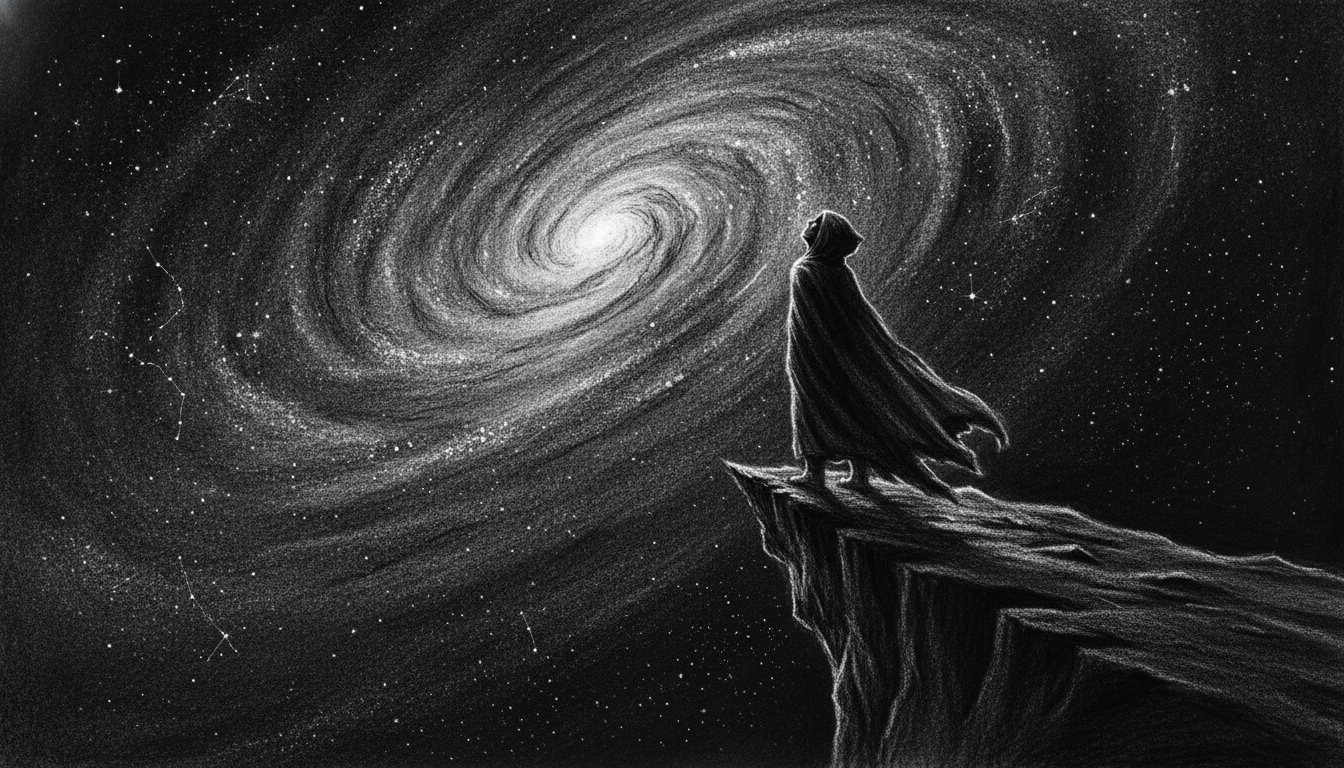
This is something I wrote while trying to reconcile the very religious people in my life with my own atheism. In the end the word ‘god’ becomes empty because it is everything. We are god along with every bit of existence. God becomes synonym for ‘universe’. The ecstasy of the dance is ours if we dare to hear the music: we are the Whirling Dervish[1].
You and I are God.
Do you grok it?[2]
A Rational God
I know the true God and God is nameless. God does not need man to shout his name from rooftops for God is nameless and nothing we do can increase God.
The one true God does not require that we prostrate ourselves before God and swear oaths of loyalty in God’s name for there is no way to be against God for there is no place where God is not and God is unnamable. There is no thing which is not God. God is the whole of creation. God does not bribe us to good deeds with promises of eternal paradise. Good acts are in and of themselves the reward. Every good act blesses us with the joy of having given and shared. There is no greater thing than to be filled with the satisfaction of having shared of one’s self, to have given where there is need, to have raised one who is low, to have supported another that is fallen. The act of giving and sharing is its own reward for it fills us with good things to remember. A good act is a selfish[3] act that raises others so that we may raise our selves. God does not threaten us with eternal suffering for wrong acts: the memories of the hurtful things we do will haunt us to the end of our days and that is the punishment for the atrocious acts. To be seen by others as an empty cup, to be denied loving communion, even for a moment, is the punishment we are dealt. When we act incorrectly, when we intend incorrectly, when we think incorrectly, we are denied the joy of having shared, we are denied the support of community. We are forever haunted by our dark deeds and God does not forgive, but neither does God judge. God does not care that you are haunted by your own acts and choices. The only relief comes from turning away from hurtful acts and acting selfishly by sharing and giving. The act of giving to others, of sharing, diminishes power of the haunting. Like bright sun lifts the fog, good acts dilute the bad memories.
God does not take joy in the hiding of knowledge, in the thwarting of discovery: God dances in ecstasy with every new discovery. As we expand the sphere of our knowing so does God grow in God’s understanding: for just as we seek to understand the whole of our creation, God seeks to understand the mystery of God’s own creation. The solving of the grand mystery of our existence is the challenge God puts before us. As we unravel the extent of universe God also seeks to understand the mystery of God’s progenitor. God looks at us, God’s creation, and watches and learns and seeks to understand the nature of existence. God questions “What came before?” God seeks to understand the mystery of creation by watching us unravel the mystery of our creation. Just as we create experiments and observe and learn so does God. God has no interest in our success or failure. God’s only interest is the flurry of activity, the sum of the discoveries. God does not impose moral laws; God does not dictate norms of behavior: that is the experiment.
The whole of our universe was created, and the physical laws took hold. The rest is on us. We are the experiment. What we do is the result. How we live, how we treat each other, how we treat those lower and higher than our selves: those are the choices we have. God thrives on discerning the choices we make.
Do not live in fear of endless damnation.
Do not live in expectation of external reward.
Be fully present and act in such a manner as to fill your cup and increase your joy by emptying your cup.
Do not spend your days in fear of God’s judgment for God does not care to judge. God is exalted in every act and every breath and the very existence of every thing seen and unseen. Do not waste a moment thinking about God’s laws because the laws are absolute: built into the fabric of universe and are unbreakable.
God is everything and everything is God.
Search every where and question all things so that understanding, God’s and our own, of the mystery of existence increases. We are God because we are the created and the creators. Do you grok it?
Albert G. Lotito
Addendum: This is another dive, a year or two later, into the same space. I as a human reserve the right to further refine my beliefs. As Walt Whitman said:
“Do I contradict myself?
Very well then, I contradict myself;
(I am large, I contain multitudes.)
Taking the above a little further I postulate that the gods we know are a purely human idea that comes out of a need to understand. There had to be a reason. Why does the sky storm? Why does the rain not fall? The attempt to answer these questions, when having not even a fundamental understanding of the laws of the universe, forced answers that put an all-powerful, invisible ruler in charge. A ruler subject to the same whims as the rulers then known, and still known, by man. This was the logical conclusion when you were a pre-enlightenment goat herd or nomad. As we learn more of the universe the goat herd’s explanation slowly becomes absurd and in stochastic bumps and shudders crumbles till there will one day be no invisible fairy man/woman in the sky.
So, This I Believe:
I am an atheist. I believe there is no god; no supreme creative, intelligent, cogent fairy that is omnipresent. I do not believe that angels and fairies, and ghosts, and demons surround us and haunt us and answer our prayers and curses.
I do believe that there are undiscovered connections between us; that there are moments of perception or connection that elude current human understanding. I believe that we shape our reality but not create it; that we choose what to perceive and deny; what to accept and discard; which path to take through the omnipresent reality. This is the shaping of our reality, and, as a group, we collectively do choose the path and shape the timbre of our lives. I believe that those who argue for the existence of angels and fairies and gods by saying ‘you don’t see because you don’t believe’ are deluded by a false argument. My answer to them is that ‘I will believe when I see’, and seeing is so much more than a visual thing: it is a gestalt, it encompasses the full range of human perception, it is an experience lived and perceived. If I experience some thing then I can believe it to be. I believe that the magic of life is full of undiscovered connections. Like when you think of a friend with whom you have not spoken in a long time and lo and behold, moments later, the phone rings and that friend is calling. Is that God? It that magic? No, it is not. Is it mysterious? Is it hard to explain by sheer co-incidence? Yes: it is a mystery, it is an unexplained connection.
I believe that there is an endless magic bag of mysteries and undiscovered connections.
I believe that we will never understand the nature of creation at its most primal and fundamental level.
I believe that just because we do not understand, and do not know, does not imply a god or supreme intelligence.
I believe that the conventional concept of god is too small and too parochial: that the gods that men create are far too human in their whims and rages.
I believe that there is no god.
I believe that if there is, by some odd chance, a supreme intelligent being it does not require my submission; that it does not require my sacrificing calves and rams and the body and blood for these are petty things that are devoid of meaning in a universe of 300 sextillion stars.
I believe that the life and death of one person or a million people is a small thing on the scale of a universe of 200 billion galaxies.
I believe that this life is the only thing we have and we should live it now without wasting time on an afterlife.
I believe that, in the immortal words of Aleister Crowley:
Do what thou wilt shall be the whole of the law.
Love is the Law, Love under will.
Albert G. Lotito
- Sufi spinning ('Whirling Dervish"): https://en.wikipedia.org/wiki/Sufi_whirling
- Grok: https://en.wikipedia.org/wiki/Grok
- Yes, to give and share is to be selfish. For it is in giving that we are full with light and feel good. In the end, all acts are fundamentally selfish. That is not a judgement of the acts; only a statement of fact that the act is selfish: it might serve to raise others and one self or raise oneself at the expense of others and there is the quality of the act.