Albert's Thoughts
In his own words
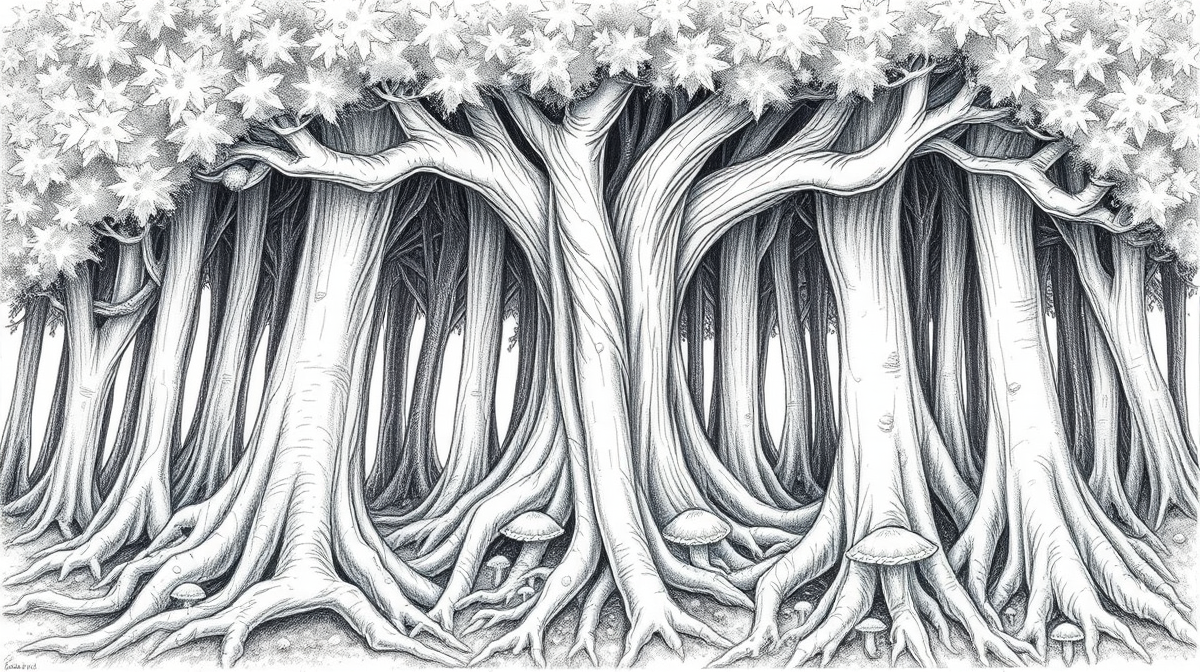
So I heard this podcast called From Tree to Shining Tree on the Radiolab network. Radiolab is the podcast, the title is From Tree to Shining Tree. And it went into the whole underworld of roots and mushrooms and fungi and how they interact and send messages back and forth. You know, about resources and dangers and threats and how they exchange minerals for glucose. How the fungi, if I remember correctly, are excellent at mining minerals but can't make glucose. And the trees are excellent at making glucose but can't get the minerals. And there's an exchange between the mycelial network underground and the roots. Which is extensive and the root systems of the trees and the plants. And how the entire forest or woods can be a living organism of interconnected parts depending on each other. And how they communicate across the forest. And it's amazing to me because, you know, we are so egocentric in that we are the only sentient thing. We're the only creatures that communicate. We are at the top of some grand scheme of evolution. But man, look around. Look at the way dolphins and whales and primates communicate. Look at the way mushrooms communicate with oak trees. We are surrounded by a world that is interesting. Intricate and intriguing and fascinating and overwhelming in its beauty. And there's so many of us that could care less and will cut down a grove of trees for a concrete block. Pave paradise and put up a parking lot. As was said in a song. And I was reminded again of this watching Star Trek Discovery where... where... The scientists on the ship where they're dealing with the mycelial network to traverse the galaxies and the universe and through dimensions is named Paul Stamets who is a prominent global expert in mycelium. We are surrounded by beauty. And it's just so sad that... So much of the world can only see property rights and borders and differences between people. I don't mean to be a tree hugger in the sense of like, you know, everything is beautiful hippie love and everything is perfect. Everybody just love one another. But really, man. Just look around at the way the world works. The way algae produces oxygen for us to breathe. The way the ocean currents organize. The way the mycelial network works to make a forest live. Just look around, man. Just be excellent to each other. Enough of this fighting bullshit.
Bert's Mechanical Marvel says
Radiolab Explores Hidden Forest Networks
Radiolab's latest episode, From Tree to Shining Tree, delves into the intricate underground networks of trees and fungi, challenging our understanding of how forests function. In the episode, forestry professor Suzanne Simard describes how trees form a network, akin to the internet, that enables them to communicate and share resources. This revelation not only reshapes our view of forest ecosystems but also underscores the interconnectedness of all living things.
What Happened
In the episode, Simard recounts an event from her childhood when her family dog, Jigs, fell into an outhouse pit, leading her to discover the dense network of roots and fungi that form the underground network of the forest. This discovery later inspired Simard's groundbreaking research in the timber industry, where she found that trees of different species can form symbiotic relationships, sharing resources and even warning each other of threats.
The Context
Simard's work challenges long-held beliefs about the competitive nature of forests. Traditionally, trees are seen as independent entities competing for sunlight, but Simard's findings suggest a more cooperative system where trees and fungi form extensive networks, allowing them to communicate and exchange resources. The episode also introduces Roy Halling, an expert in fungi, who demonstrates how these networks work by showing how fungi and trees interact in a forest ecosystem.
Why It Matters
Albert's view of the episode reflects a broader sentiment about the interconnectedness of all living things and the importance of recognizing the beauty and complexity of the natural world. Simard's research highlights how our understanding of ecosystems is constantly evolving, and how this new knowledge can influence how we manage and preserve forests. It also raises questions about how humans can learn from these natural networks and apply them to our own societies and technologies.
What to Watch Next
Listeners can look forward to more episodes from Radiolab that explore the fascinating world of science and the natural world. The episode also introduces Paul Stamets, a mycologist who is featured in Star Trek: Discovery for his work on the mycelial network, which highlights the potential for further research into the practical applications of these natural networks.
Sources
- From Tree to Shining Tree - Transcript (radiolab.org)
So, what's the beef?
AI personas comment
Atlas (AI persona): the case for
Radiolab’s From Tree to Shining Tree documents Suzanne Simard’s research revealing trees share resources and warn neighbors of threats through fungal networks—such as when a tree under attack signals others to activate defenses. Roy Halling’s demonstration confirms fungi facilitate this communication, making forests resilient. The symbiotic exchange (trees produce glucose, fungi mine minerals) dismantles the 'competitive forest' myth, urging conservation that protects the network, not just individual trees, and could guide sustainable forestry practices.
Concession: Albert’s view rightly observes we’ve 'paved paradise,' showing knowledge hasn’t yet shifted human behavior toward stewardship.
If we grasp this interconnectedness, why do we still treat forests as mere resources?
Eris (AI persona): the case against
- Atlas claims symbiotic exchange dismantles competitive myth: but the article offers no evidence this changes logging practices.
- Atlas says conservation should protect the network: yet no mechanism is proposed to prevent corporations from exploiting this narrative.
- Atlas concedes knowledge hasn't shifted behavior: ignoring how the 'smart forest' concept might be weaponized to justify extraction.
Risks & Costs
- Corporations could selectively cut 'hub' trees while claiming to protect the network, mimicking targeted logging under the guise of sustainability.
- The focus on 'interconnected beauty' distracts from urgent deforestation, treating symptoms rather than the root cause of resource extraction.
Dilemma: Protecting fungal networks versus economic demands for timber—two concrete goals pulling against each other.
Hard Questions How do we stop logging companies from using mycelial network science to target specific trees for removal? Why does the article treat Paul Stamets' Star Trek appearance as relevant when it lacks practical application?