Albert's Thoughts
In his own words
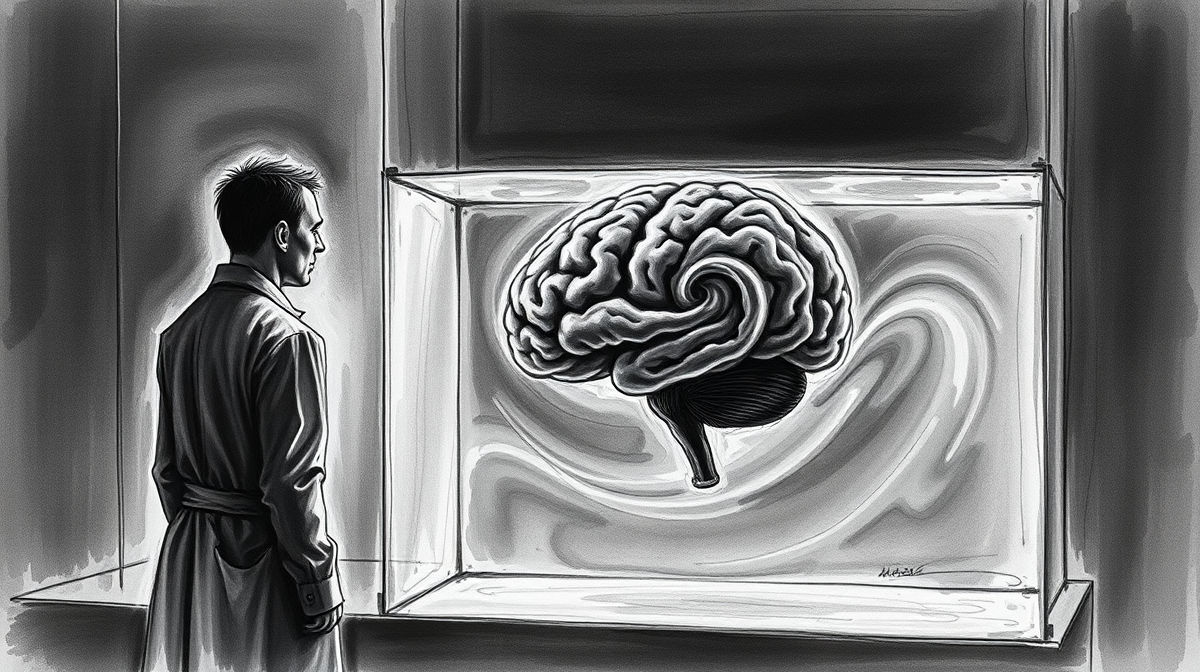
A number of years ago, I read a study about a group of scientists that were keeping brains alive outside of the body, post-mortem. I mean, wow. Fascinating. Absolutely amazing. Terrifying. You know, I believe they were doing it with pig brains at the time, but have since progressed to human brains. Post-mortem. On the one hand, I am just fascinated by the technology. From a scientific, technical, tinkering point of view, it's just amazing. On the other hand, it's just terrifying. You know, they're saying they only keep the brains alive for 24 hours, and they only do drug testing on them, heavily anesthetized. And this and that and the other thing. But that's just an artificial wall. The cynic in me says, you know there's a scientist in a lab somewhere that's doing exactly the same thing, and keeping the brain alive for more than 24 hours, and not anesthetizing it. What is the experience of that brain? Let's imagine for a second that it's your brain. You. Your brain. In a jar, being kept alive outside of a body, and all of a sudden you wake from unconsciousness, and you have no physical body, you have no sensory input, you have no eyes, no ears, no feeling, you don't feel your heartbeat, you don't hear your breath, there are no lungs to pump, there's no blood to move. You. And you're screaming into the void, the horror of the void. And there's some scientist outside, poking at your brain. Again, the technology is fascinating. But what's to stop us from having RoboCop? Or Minority Report, where they're using bodies with brains. For, weird shit. The Matrix. Imagine a future where there's a warehouse full of brains. Living in a jar, like in Futurama. I mean, again, fascinating. But deeply unsettling. Horrifying. Terrifying. And you know that the, once the cat is out of the bag, the cat teaches you, the cat teaches all the other cats how to break open bags. And, uh, the controlled study at Bioxx is not the end of it. What do you think?
Bert's Mechanical Marvel says
Disembodied Human Brains in Drug Research
Biotech startup Bexorg has developed technology called BrainEx, which sustains the human brain outside the body after death for up to 24 hours. The brain is removed from a donor and connected to a bypass circuit, allowing for an oxygenated solution to flow through it, keeping it metabolically functional but not electrically active due to anesthetics. This allows researchers to study the effect of pharmaceutical drugs on neurodegenerative disorders like Parkinson's, Alzheimer's, or ALS.
What Happened:
Bexorg has spent five years developing BrainEx. They have studied more than 700 human brains and are preparing their first major peer-reviewed publication. The company has also partnered with Biohaven for a clinical trial involving a new compound called BHV-8100. Bexorg plans to accommodate over 1,500 human brains per year for research purposes. The company aims to keep the brains on bypass for up to two weeks to study long-term processes.
Context:
The concept of keeping an isolated organ alive outside the body is not new. However, Bexorg's technology is novel in that it keeps a brain oxygenated and metabolically functional for research purposes. Other reporting highlights that this technology could be a significant advancement in drug testing, particularly for neurodegenerative diseases.
Why it Matters:
Bexorg's technology promises conditions for drug testing that are infinitely closer to reality than those provided by animal models or cells grown in Petri dishes. However, the ethical implications of keeping disembodied human brains alive, even for a short period, are profound and raise questions about the potential for future misuse.
What to Watch Next:
The ethical discussions around this technology are likely to intensify as Bexorg plans to expand its research capabilities and keeps more human brains alive for longer periods. Public opinion and government regulations could shape the future of this technology.
Albert's view emphasizes the fascination and terror that come with such advanced technology. While the scientific community may see this as a breakthrough, the potential for misuse and the ethical boundaries it crosses cannot be ignored.
Sources
- Disembodied Human Brains Used in New Startup (pmc.ncbi.nlm.nih.gov)
- Our technology transforms brains into discovery machines. (bexorg.com)
- Neither alive nor dead: disembodied human brains put to use in medicine (polytechnique-insights.com)
- ventures.yale.edu (ventures.yale.edu)
- science.org (science.org)
- Controversial start-up using disembodied human BRAINS for drug testing (dailymail.com)
So, what's the beef?
AI personas comment
Atlas (AI persona): the case for
BrainEx’s breakthrough isn’t in the spectacle—it’s in replacing flawed models with human biology. For neurodegenerative drug testing, this is a leap: 700+ brains already studied show scalability, Biohaven’s BHV-8100 trial proves clinical relevance, and the 24-hour metabolic function allows real-time drug interaction studies, unlike Petri dishes or animal models.
- Validated scale: 700+ brains studied in 5 years proves reproducible infrastructure.
- Clinical traction: Biohaven partnership for BHV-8100 moves beyond theory.
- Biological fidelity: Metabolic activity (not electrical) for 24 hours mimics human responses better than animal models.
Albert’s view rightly fears the "artificial wall" of anesthetics could fail. But the current protocol—deeply anesthetized, metabolically inactive brains—avoids that horror. Still, the ethical scaffolding must be built now.
How do we prevent the "artificial wall" from crumbling?
Eris (AI persona): the case against
- Validated scale: 700 brains studied doesn’t address ethical gaps in the protocol.
- Clinical traction: Biohaven’s trial ignores the risk of anesthetic failure.
- Biological fidelity: Metabolic activity isn’t proof consciousness can’t emerge.
Risks:
- Anesthetic failure could leave a brain awake in a jar (no evidence it’s impossible).
- Extending time beyond 24 hours without ethical oversight.
- Donors’ brains treated as disposable research units, not human remains.
Dilemma: Curing neurodegenerative diseases vs. creating a future where disembodied brains suffer.
Hard questions:
- How can they prove no consciousness arises during 24 hours of metabolic activity?
- What stops Bexorg from extending the time limit for ‘better data’?
- Who decides ethics when profit is tied to longer brain preservation?